West Jutland
Early on Tuesday morning (08/05/2014) we set off from the campsite in Randbøl to the west coast of Denmark - West Jutland. It is the least densely populated region of Denmark. The landscape there is very interesting - a spit between Ringkøbing Fjord and the North Sea.
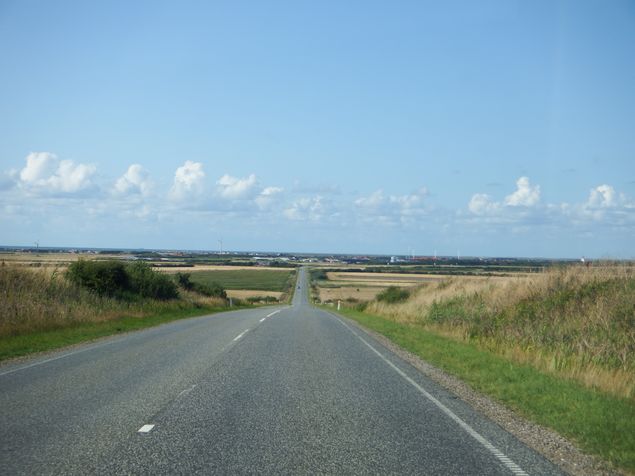
We drove to Nymindegab and continued north to the town of Hvide Sande. The spit is only several hundred meters wide. In the middle there is one paved road, and along it there are buildings hidden in the rolling terrain. There is almost no traffic, once in a while a car or cyclist appears.

Hvide Sande
Hvide Sande is a small port town, which is famous for its fishing. There is a bridge over the canal that connects the fjord with the North Sea. Further north we visited the Lyngvig Fyr lighthouse. It is a 38-meter-high structure that emerges from the dunes. We decided to visit it. The entrance is ticketed, but it's worth going upstairs to see the panorama of the entire spit and fjord. Tickets are only for adults (children enter for free) and cost 40 DKK. At the foot of the lighthouse there is a small museum and a playground for children - available outside the ticketed area. The main attraction of the playground was a zip line. You can see the kids having fun in our video.
Good to know: 159 steps lead up to the viewing balcony of Lyngvig Fyr. The lighthouse was built in 1906 on a 17-meter dune, so its light shines 53 m above sea level.

We continued the journey north, heading to another spit between the Nissum Fjord and the North Sea. We drove through the village of Thorsminde on our way to Thyborøn. Along the way we passed through the town of Lemvig, where we stocked up on food.
In this area there are a lot of wind farms that produce green energy. There are no high buildings or blocks of flats, just small one-family houses and small wooden one-story houses in larger cities. On many houses the Danish flag is prominently displayed. In Poland flags hang only on holidays - here they hang every day.
Thyborøn
Thyborøn is a small port town with a rich (though short) history - its harbor was built between 1915 and 1918. This location was of strategic importance during World War II. If captured, the town at the mouth of the Limfjord could have paralyzed Jutland and allowed an attack from inside the fjord. This weak point was heavily guarded and fortified with bunkers against a potential Allied attack.
These coastal fortifications are part of the Atlantic Wall, which stretched along the western coast of Europe from the Spanish border to Norway. Built by the Nazis, it was meant to stop an Allied invasion of the European continent. The bunkers still stand today, and although they no longer serve any defensive purpose, they are reminders of the past. Interestingly, during the war, those near Thyborøn were never used in combat. The Allies made their main landing in Normandy, which was less heavily fortified. There are 66 large and 40 small bunkers around Thyborøn. This number is impressive.

In Thyborøn we found a beautiful museum of shells (Sneglehuset), but unfortunately we arrived too late to go inside. From the outside, however, the building was very beautiful. Inside there is supposedly Denmark's largest collection of ships in bottles.
Fun fact: Sneglehuset, the "Snail House", was decorated by a local fisherman, Alfred Pedersen. He started in 1949 and finished in 1974, after 25 years of work. Tens of thousands of shells cover the walls inside and out. He had promised his wife a house like no other, one that people would travel from far away to see.

There is no road from Thyborøn to the north. However, there is a ferry, and that way we managed to get to the other side. The ferry runs quite often and we did not wait too long for the crossing.
Agger
The ferry lands on road No. 181, which leads to the village of Agger. The spit there was only a dozen or so meters wide, so it is even more interesting than the Hel Peninsula in Poland. Interestingly, the seaward side is protected by dozens of breakwaters to prevent the destruction of this unique place.


Krik Vig Camping
In the suburbs of Agger we found Krik Vig Camping, which was our place of accommodation. The campsite was very large and spacious. We arrived at a time of quite low occupancy, so it was quiet and calm. At the campsite we paid only for what we used, for example hot water. We got a prepaid card that tracked how much water we used. Kitchen, toilets - it was all free. Wifi was available for an extra daily charge. We didn’t use it because we were only there for a few hours and we just didn't need it. There was a special area for campervans, used mainly by travelers staying for one night.
While we were cooking, the children had fun on the playground, where the main attraction was an inflatable trampoline. This form of entertainment is very popular in Denmark, and completely unknown in Poland.
In the morning there was a short rain shower, after which the children decided to play on the trampolines. It is not hard to imagine - they got totally wet after that. The children were extremely happy. In the end, we let them do whatever they wanted.
Here’s a video from this day of our trip:
More from our trips
Watch the videos from our trips on YouTube and see photos from the road on Instagram.