
In July 2018, we were staying at Camping Cortina in the Dolomites. A few days earlier, we had arrived here via the Grossglockner High Alpine Road in Austria. This time, a completely different kind of adventure was waiting for us. Not a scenic drive through mountain passes, but a mountain where soldiers had carved tunnels into rock more than a hundred years ago.
The Drive to Passo Falzarego
In the morning, we packed up and headed towards Passo Falzarego. The road from Cortina d’Ampezzo to the pass winds through sharp turns, and with every bend the views become more and more impressive. The Dolomite peaks rise from green meadows like giant stone towers. Our four kids were taking turns looking out the window and fighting over the best seat.
At Passo Falzarego, at an altitude of over 2,100 metres, you will find the lower station of the cable car to Monte Lagazuoi. The parking area was well marked and the whole place was set up for visitors. We bought tickets for the funivia – a cable car that takes you up to 2,778 metres in just a few minutes.
At the top
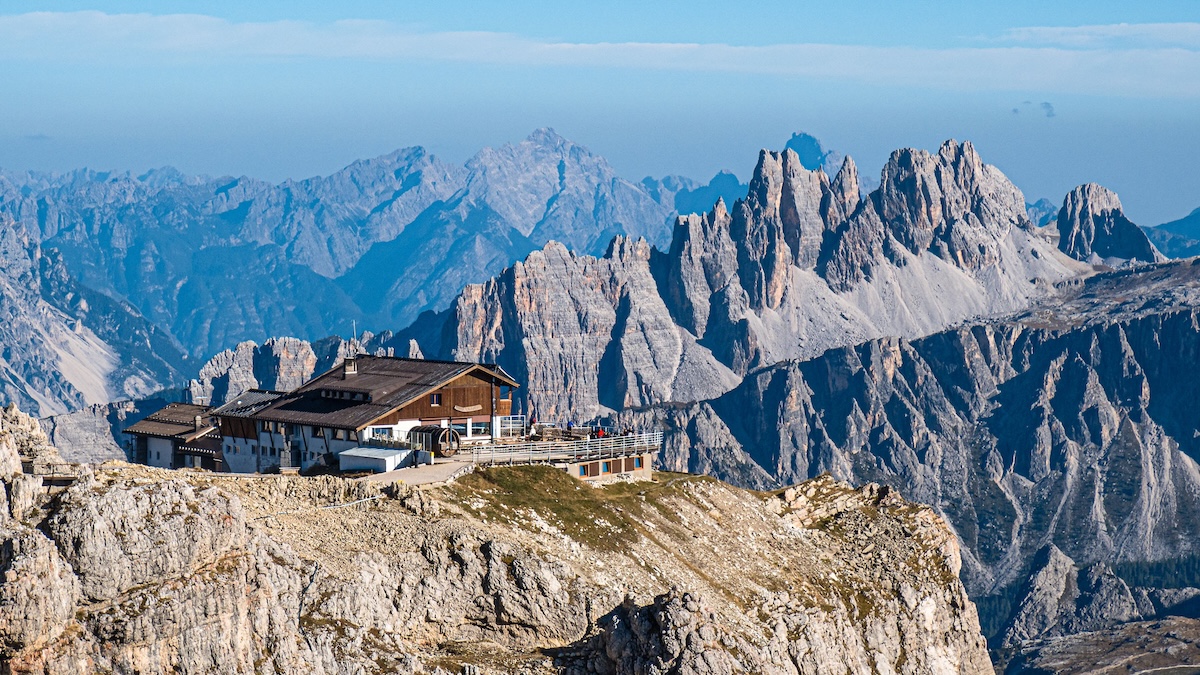
The ride up is an experience on its own. The cabin rises above steep rock walls, and the view gets wider with every second. At the top, there is a mountain hut called Rifugio Lagazuoi and a panorama that is hard to look away from – you can see Marmolada, Tofane, Cinque Torri, and dozens of other Dolomite peaks.
We had brought inflatable sofas with us, and in the strong wind at the top they filled up in seconds. A moment of rest on a sofa with that kind of view is something hard to repeat anywhere else.
But the views were not the main reason we came here. Or at least – not the only reason.
Tunnels and trenches
Monte Lagazuoi is one of the most remarkable World War I sites in the Alps. Between 1915 and 1918, the Alpine front ran through this area – a battle line between Italy and Austria-Hungary. Both sides built large tunnel systems, trenches, and gun positions deep into the rock. Soldiers lived and fought at nearly three thousand metres, in extreme cold. Avalanches were just as dangerous as enemy fire.
Today, these positions are preserved as an open-air museum. From the summit, we started hiking down along a trail that passes through the old Italian army positions. The path leads through tunnels carved into the rock – some of them are narrow and dark, while others open up to the outside, showing shooting positions with views over the valley.
The kids reacted in ways we did not expect. Krzys wanted to know how the soldiers ate and slept in such conditions. Agata looked nervously into the dark corridors. The younger ones – Justyna and Iwona – treated the tunnels more like a big adventure, not fully understanding the historical context yet. And that was probably fine – it was enough that they could feel the atmosphere of the place.
Walking through the war positions is powerful, no matter your age. You can see the shooting holes, remains of fortifications, and spots where soldiers spent weeks at a time. It is hard to imagine daily life at this altitude, inside rock, with the enemy just on the other side of the ridge.
The way down
The trail down is steep, with safety ropes in some places, but it is perfectly manageable for a family with kids – as long as the children like hiking and have proper shoes. Our four managed without any big problems, although by the end their legs were getting a bit tired.
The hike down took us about two and a half hours, with plenty of stops to look at more tunnels and take photos. At the bottom, back at Passo Falzarego, our car and a well-earned snack were waiting for us.
Summary
Monte Lagazuoi is a place that combines history, nature, and mountain adventure all in one. For us, it was one of the most interesting spots during our stay in the Dolomites. In the evening, we returned to the campsite in Cortina, tired but impressed by what we had seen. The next day, more Dolomite trails were ahead – but that is a story for another post.