
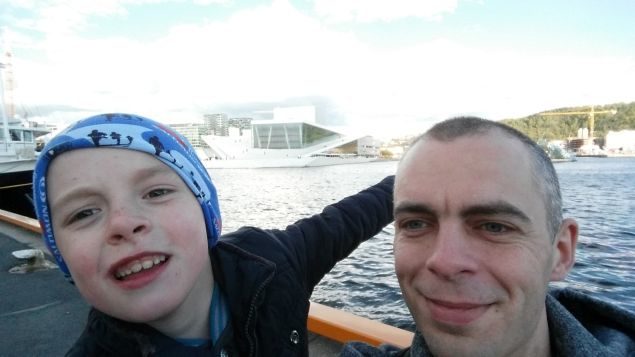
We are standing on the roof of the Oslo Opera House, which slopes gently down to the water, while huge passenger ferries come right up to the nearby quay. Over the May Day long weekend in 2015 four of us flew to Norway: a dad with his son and the grandparents. We found cheap flights by chance, and with just one day off work we had four days in Oslo, from the morning of 30 April to the evening of 3 May. You can watch the whole trip on our playlist Norway 2015 - Oslo.
We didn't rent a car, because adding child seats made it far too expensive for us. Instead we got around on foot and by tram, metro and ferry. Norway is one of the most expensive countries in Europe, but many of Oslo's sights are free, and museums and parks had playgrounds, drawing corners and things kids could switch on themselves. We describe how we planned the trip in Long weekend in Norway, and our arrival and first evening in Oslo.
- Norway with kids at a glance
- Practical info: documents, money, road tolls
- Best places in Norway for kids
- All posts: Norway
Norway with kids at a glance
- Our trip: the May Day long weekend in 2015, four days in Oslo without a car, with our son and his grandparents.
- Getting there: we flew on a budget airline from Poznań in Poland. The flight took about an hour and a half and cost us about PLN 100 per person, seat reservation included (in 2015). We landed at Rygge Airport near Moss, 70 km from Oslo. Rygge closed to civilian flights on 1 November 2016, so today you need to fly to a different airport.
- Where we stayed: a hotel in the city centre, a few minutes' walk from the station, with a view of the Opera House from the top floors and a 24-hour buffet with coffee, tea and hot chocolate, which our son loved.
- Who it's for: kids who like ships, Vikings, ski jumps and playgrounds. The museums on Bygdøy vary a lot: you can see some in fifteen minutes and spend much longer in others.
- How much time: plan a whole day for the museums on the Bygdøy peninsula and about an hour and a half for Vigeland Park, plus playground time. In four days we saw everything described below.
Practical info
Documents for children
Norway is not in the European Union, but it is part of the Schengen area (as of November 2026):
- EU citizens can travel with a valid passport or national ID card,
- every child needs their own passport or ID card,
- if you are not an EU citizen, check the entry and visa rules with the Norwegian Directorate of Immigration (UDI) before you book,
- Norway carries out temporary checks at ports with ferry connections to the Schengen area, notified until 11 May 2027, so keep the whole family's documents at hand.
Money and payments
Norway uses the Norwegian krone (NOK). Almost everywhere takes cards and phone payments, foreign currency is rarely accepted, and it's handy to carry a little cash for small purchases (as of November 2026). Prices can be high: in 2015 a basic burger on Karl Johans gate cost about NOK 140. After this trip we had some Norwegian kroner left in our wallet, and a year later, at the till on the ferry to Bornholm, we found them mixed in with our Danish ones.
Getting around Oslo
From the airport we took the train to Oslo Central Station, and children travelled free with an adult. On the 1 May public holiday up to four children under 16 could ride city transport for free with an adult who had a full-price ticket. For our museum day we bought a 24-hour Oslo Pass (NOK 320 for adults and NOK 160 for children), which covered entry fees and public transport and had paid for itself by the third museum. These are prices and rules from 2015, so check the current ones before you go.
Road tolls and ferries
We only used public transport, but if you drive to Norway in your own car, keep these rules in mind (as of November 2026):
- all vehicles pay road tolls, and toll stations are automatic: cameras read your number plate,
- most car ferries are paid through the same AutoPASS system,
- as a visitor with a foreign-registered car, the simplest way is to register it with Epass24 before the trip and add a payment card, so tolls are charged automatically,
- without registration the invoice goes to the car's owner with an extra fee for looking up their details, which depends on the country of registration,
- dipped headlights must be on at all times, even on the brightest summer day.
Best time to go
In early May it was about 10°C in Oslo, but in the sun we walked around in T-shirts. Watch out for public holidays: 1 May and 17 May are days off in Norway, most shops are closed and public transport runs less often. On 1 May we came across a parade, closed museums and trams stopped for a few hours, so we spent that day in Vigeland Park and at other outdoor sights.
Best places in Norway for kids
Central Oslo and the harbour
Oslo Opera House and Akershus Fortress
You walk up the sloping roof of the Opera House as if it were a hill, and from the top you can see the whole city and the fjord. Next door is Akershus Fortress, free to explore, with cannons on the walls and the Royal Guard on duty (see our film from the fortress). Read more in Oslo Opera and Akershus Fortress.
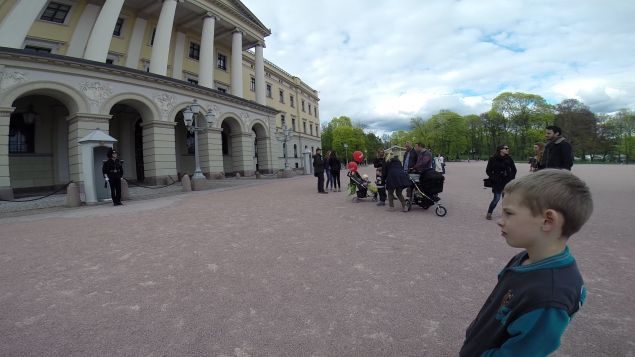
Karl Johans gate
Oslo's most famous street is a long pedestrian stretch from the Royal Palace down to the railway station. On the way you pass:
- soldiers on guard in front of the palace and a statue of the king on horseback,
- the National Theatre, the parliament and the university,
- Spikersuppa park with a fountain, which is said to become an ice rink in winter,
- souvenir shops full of trolls.
Our walk along it is in this film. See Karl Johans Gate.
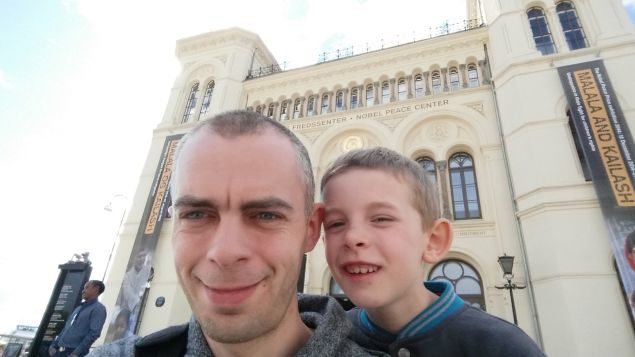
Nobel Peace Center
A small museum in a former railway station, where almost everything is shown on screens and projectors:
- portraits of the laureates that are actually displays, not photos,
- a timeline you move with a slider,
- a blank book that a projector turns into Nobel's will as you turn the pages,
- a game for kids with cards to collect.
In 2015 children under 16 went in free (a few shots from our camera). Read more in Nobel Peace Center.
Vigeland Park and the hills above the city
Vigeland Park
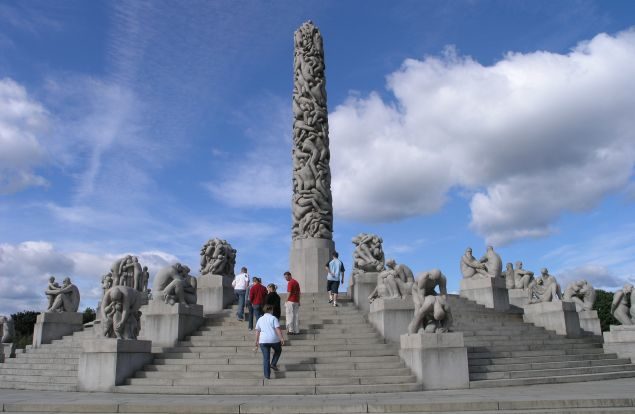
More than 200 sculptures, the 14-metre Monolith and the famous angry little boy, where people queue for photos. By the main gate there is a big playground with challenging climbing frames that was hard to leave. Entry is free and the park is open 24 hours a day (as of November 2026). Read more in Vigeland Park.
Holmenkollen Ski Jump
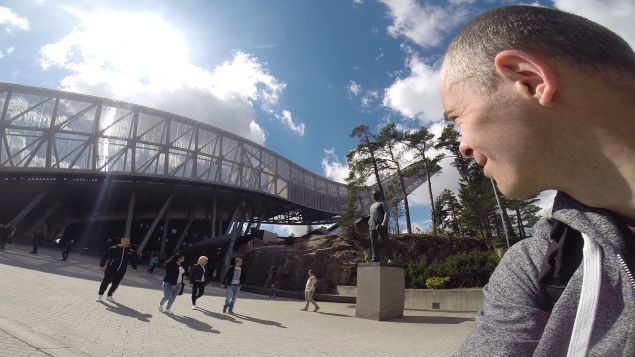
Metro line 1 climbs a winding hillside with views over the city right up to the famous ski jump. You can ride a zip line down from the top, and under the jump there is a simulator where for a few minutes you feel what a ski jump and a giant slalom run are like. See Holmenkollen Ski Jump Arena.
Ekeberg Hill
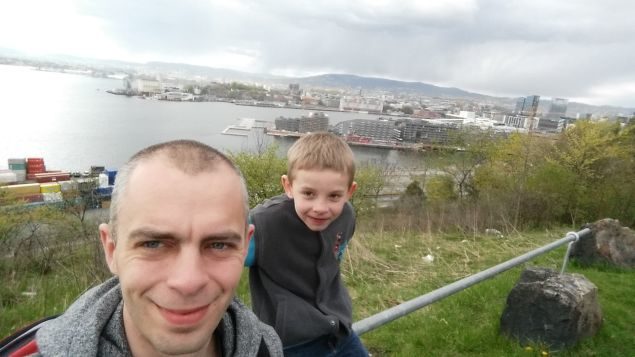
From this hill Edvard Munch looked down at the city before he painted "The Scream". At the campsite next door we had fun on a rope course, and in the woods we found a "glass room" whose walls work like funhouse mirrors. Read more in Ekeberg Hill.
Bygdøy peninsula: a day of museums
Viking Ship Museum
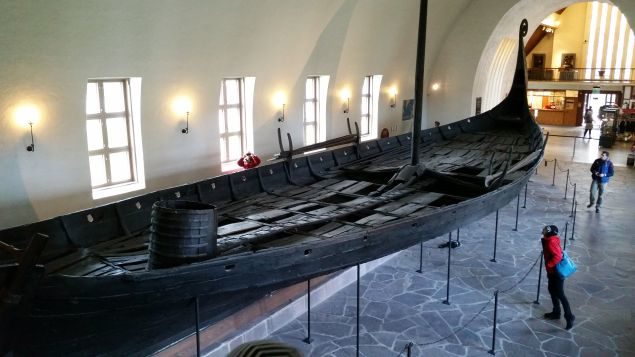
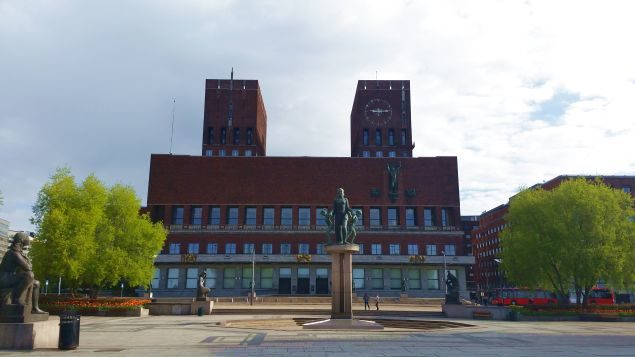
We took the ferry to Bygdøy from the City Hall pier, and our first stop was the Viking ships from Oseberg, Gokstad and Tune (see them in our film). The old museum closed in 2021, and the new Museum of the Viking Age is being built on the same site, with opening planned for late 2027 (as of November 2026). See Viking ship museum.
Norwegian Museum of Cultural History
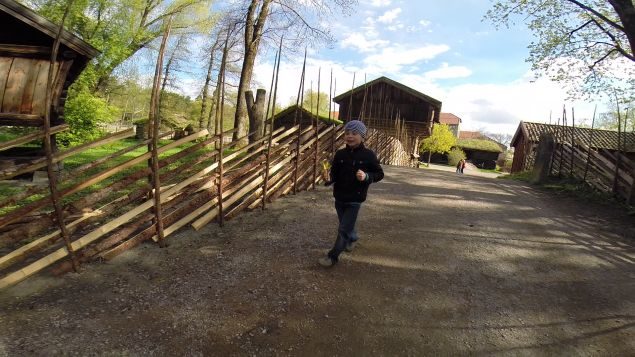
An open-air museum with 155 buildings from all over Norway, including the wooden stave church from Gol. You can look inside most of the cottages, bread is baked in the bakery, and there is a playground for kids who get bored, as you can see in our film. Read more in Norwegian Museum of Cultural History.
Kon-Tiki Museum
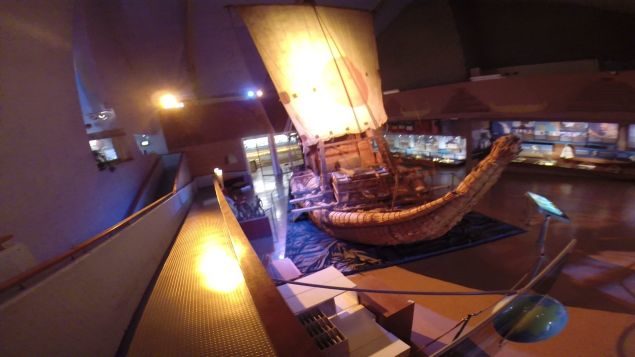
The real balsa wood raft on which Thor Heyerdahl crossed the Pacific, and a 10-metre copy of an Easter Island statue. This is where we realised a sweatshirt had been left behind in the previous museum, so it was back on the bus to fetch it (our film from the museum). See Kon-Tiki Museum.
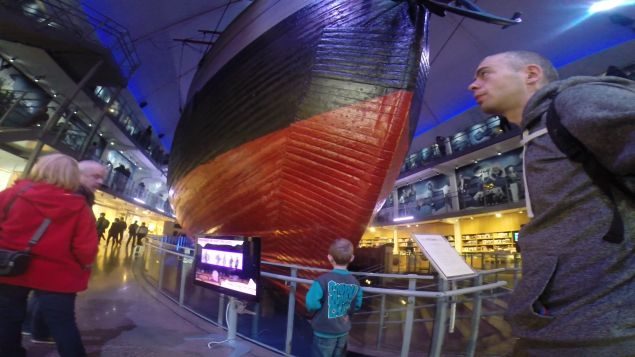
Fram Polar Ship Museum
Our favourite museum that day. You board Nansen's and Amundsen's ship from a balcony, and below deck you can peek into the cabins, the engine room and the ship doctor's room, complete with tooth-pulling pliers. Read more in Polar Ship Museum FRAM.
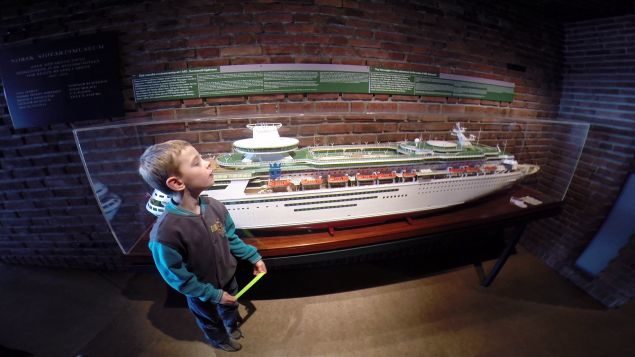
Norwegian Maritime Museum
The biggest of the museums we visited that day, all about ships, fishing and seafaring. The favourite was a model ship engine where the pistons start moving at the push of a button, and a drawing from the kids' corner ended up on the wall (our film from the visit). See Norwegian Maritime Museum.
All posts: Norway
- Karl Johans Gate
- Nobel Peace Center
- Norwegian Maritime Museum
- Polar Ship Museum FRAM
- Kon-Tiki Museum
- Norwegian Museum of Cultural History
- Viking ship museum
- Ekeberg Hill
- Holmenkollen Ski Jump Arena
- Vigeland Park
- Oslo Opera and Akershus Fortress
- Oslo
- Long weekend in Norway
Last updated: November 2026