
Międzyrzecz Fortified Region, commonly called the MFR, is a belt of fortifications built between 1934 and 1944 by the Germans in order to defend the eastern border. Barely a dozen kilometers from the border, planned fortification areas sealed the gaps between the Oder and the Warta. And yes, all inlets between the lakes were fortified, on the ground surface stood bunkers (Panzerwerk) and underground combined into a single system of underground fortifications.

The original plan was to build 107 shelters, but the plan was not completed. If they had finished building it, it would have been the most powerful line of fortifications in the world. The Germans managed to finish only the central section, which has survived to this day. The fortification system was never armed or used militarily. When the Russian army went to Berlin they drove along the road next to the “dragon teeth” – special defenses designed to stop tanks. The cost of building the system was huge and exceeded the estimated budget several times over. In the meantime, they changed strategy and used the underground for factory purposes to produce aircraft engines, which were apparently more needed.

After WWII the complex was empty. The Russians set up a training ground here to have space for testing weapons by blowing up various shelters. They tried to remove metal parts, but fortunately without success. In the ’80s the Polish government almost created a warehouse for radioactive materials here (what a concept!). Until the 90s the building was not used. Today, in the middle of the complex is a bat reserve, with more than 30,000 individuals wintering there.
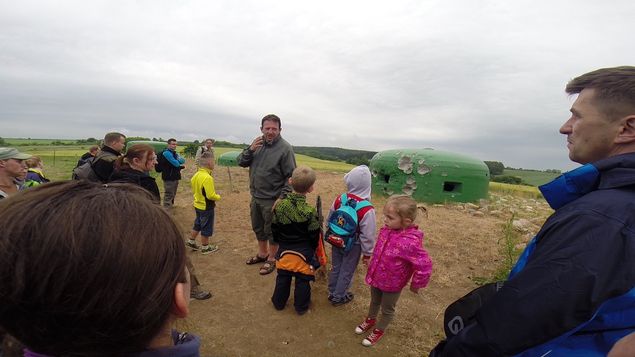
MFR can be visited both on the surface and underground. Of course, the underground part is more interesting and is the main attraction of this place. You can see the size of whole fortification system. The underground can be visited with a guide only, and we have to choose between two starting points: in Pniewo and Boryszyn. We went to Pniewo. In Pniewo there is an exhibition hall with museum of military equipment. Right next to the museum building Panzerwerk 717 is located which allows us to descend into the underground.

The guide told us the history of this place, mentioned a moment ago. Fortifications conceal many secrets. They were used, e.g., to hide valuable porcelain. We heard a lot of interesting anecdotes related to the fortifications.

The underground has a constant temperature in the range of 9–12 °C. You should also bring a flashlight while exploring. Only a small part of the corridor is illuminated. While visiting we had a choice of two routes: short and long. We decided on the long one, because it wasn’t our first trip with children underground. In this way, both we and the children could get more out of this experience. We had a great guide who told us about the defenses in an entertaining way. It is worth mentioning that we were extremely lucky, as our guide at the MFR was a man with a great passion for fortifications – Mr. Jacek Podemski, who leads the television program “No Trespassing.”

Children, thanks to such expeditions, learn a little history and understand what humans are able to create. During our vacation in Denmark we saw fortifications in Thyborøn built on the embankment of the Atlantic beach. The children brilliantly remembered this fact when we visited MFR.

Above you can see the dragon teeth, a slightly disappointed Justine, who thought that she would find a real dragon.
You need to visit YouTube to see our video tour of the MFR trip: